

Growing up in Jamshedpur, the Mecca of steelmaking, life felt like a level playing field. I had short hair, raced the boys on the track, believed that nothing could stop me from excelling in academic, sports or public speaking. Some may say, I was very competitive, but I was merely mimicking those who were allowed to stay outdoors, who wore bruised knees as badges of honor, clinking medals adorned on sun-tanned skin and had calf muscles to die for.
I learnt that with skill and hard work, I could achieve pretty much anything. My parents were progressive enough to think that becoming a metallurgical engineer made perfect sense for their daughter. After all, in a city built on steel, what better future than one forged in it?
But I soon discovered that it takes more than skills and effort to thrive in college or at work.
A Minority in the Halls of Merit
When I entered IIT, I was one of just 34 girls in a batch of nearly 700 students. At least Metallurgy was better than Mechanical Engineering that year, which had one woman “holding the fort.” In classrooms and labs, the ratio was not just a number; it defined how you were seen, spoken to, and sometimes, how much you spoke.
Unlike students in the social sciences, we were never taught or trained to have the vocabulary to articulate what it meant to live and learn in a gendered world. When you’re five percent of the class, you’re both visible and invisible, grateful to be there, but aware that your every move is amplified. As in any society where norms are set by the majority, we were learning how to adapt where the boys were the norm. Each one of my female classmates went above and beyond to excel. We dressed for utility, adopted the “tough engineer” persona, that became our silent uniforms of belonging.
Acceptance came in many forms: blending in, toughening up, or occasionally, opting out. We were respected for having made it, yes, but were also pedestalized. We were also envied for being preferentially treated. Because the other 3 secretaries of the electronics club thought that one female secretary had an easy interview because of her gender.
Sisterhood and Silent Struggles
The girls’ hostel became our safe haven. As hostel president, I witnessed both the quiet strength and the hidden struggles that often went unseen. Academic pressure combined with the emotional turbulence of adolescence was no small weight to carry. Some students were dealing with personal losses, health challenges, or questions of identity all while meeting the relentless demands of IIT life.
Some couldn’t take it. A few are no longer with us. It remains a sobering reminder that meritocratic spaces often overlook the human need for care, empathy, and mental health support.
But there was also camaraderie, shared laughter during late-night errands to the canteen, whispered confessions before exams, collective pride when one of us topped a course or aced a project. Those years taught me that community is not just a comfort, it’s a survival strategy.
Policy as a Catalyst for Change
Much has changed since those days. IITs now have a quota ensuring at least 20 percent of seats for women. It’s a transformative policy, one that not only opens doors but also shifts mindsets of families, schools, and society. When parents see a higher probability of success, they’re more likely to encourage daughters to try.
Policies like these challenge self-limiting beliefs. They show that representation doesn’t dilute merit, it expands it. Academia, after all, stands at the crucial intersection of society and workforce. If universities can normalize women’s presence in scientific spaces, industries will have no excuse to say “we couldn’t find qualified women.”
From Classrooms to the Oilfields
After graduation, I carried those lessons into the oil and gas sector, an environment even more skewed. My first year as an oilfield engineer was spent across remote rigs where I was often the only woman.
Field life was a test of endurance. Water shortages made menstruation management a daily logistical challenge. Safety meant guarding against occupational hazards, not harassment; the idea of “women’s safety” simply didn’t make the checklist.
The technicians and engineers I worked with respected skill above all. Once they saw I could troubleshoot and handle a shift, I was one of them. Still, it was clear that these workplaces weren’t designed for women, they merely accommodated us. The design of the jumpsuits, no separate facilities for women and the shifts & systems have barely ever anticipated the needs of a working mother. Minority barely determined the policy for the majority. I wish like politics, even workplaces saw us as a vote bank.
That experience cemented my belief that inclusion cannot depend on individual resilience, it must be engineered into the system.
From Personal Lessons to Institutional Change
Years later, when I joined Johns Hopkins University’s Gupta-Klinsky India Institute (GKII), the questions I carried from IIT and the oilfields resurfaced:
Why are there so few women leading scientific research in India? What would it take to change that pipeline not just at entry, but through leadership?
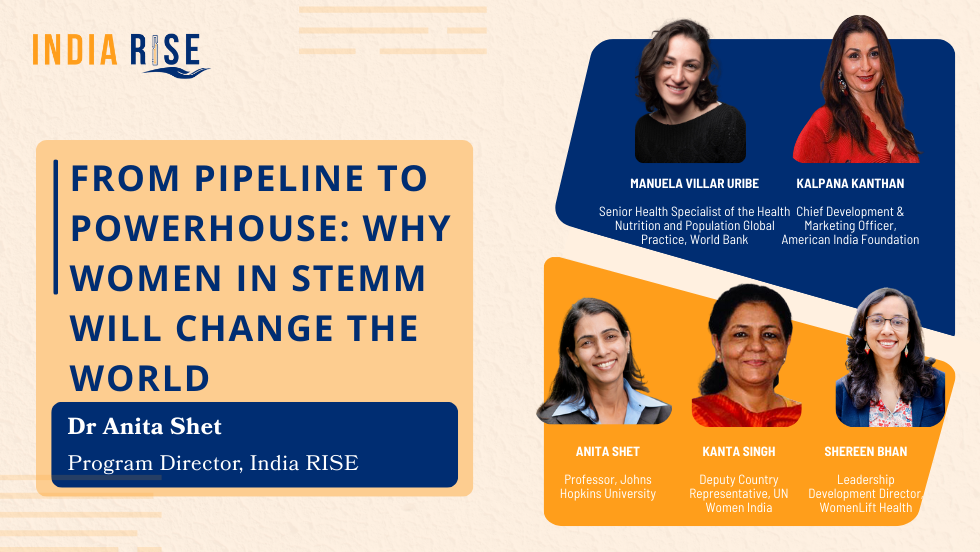
These reflections led to the creation of the India RISE Fellowship a flagship initiative that I now lead. RISE (Research, Innovation, Science, and Empowerment) is designed to strengthen the leadership, research capacity, and visibility of early-career Indian women in STEMM. It connects fellows with senior mentors from India and the U.S., equips them with leadership training, and creates networks for global collaboration.
Through RISE, I see how policies, mentorship, and representation can together transform trajectories. Each fellow’s journey reaffirms what I witnessed years ago: women don’t lack capability they lack systemic support.
The Road Ahead
Representation begets participation. But participation alone isn’t enough. We need persistence and progression. Academia must continue to be the laboratory where gender equity is not just researched but practiced.
We have made progress in classrooms; now the challenge lies in ensuring those women enter and stay in the workforce, in labs, and in leadership. Universities must show corporates and governments that equity is achievable and sustainable, when designed intentionally.
From IIT classrooms to oil rigs, and now to building pathways for the next generation of women in STEMM, I’ve come to realize this: we don’t just need more women in the system; we need to re-engineer the system itself.