



India RISE Fellowship 2026 Launch
Highlights from India RISE Fellowship launch, including the inaugural launch at IISc Bengaluru, leadership workshops, mentorship panels, and industry site visits that advance women’s leadership in STEMM.

Highlights from India RISE Fellowship launch, including the inaugural launch at IISc Bengaluru, leadership workshops, mentorship panels, and industry site visits that advance women’s leadership in STEMM.

India is often described as a country with a robust legal framework for gender equality at work. Constitutional guarantees, maternity benefits, workplace safety laws, and equal pay provisions together suggest a strong commitment to women’s rights in the labour market. Yet, when measured by outcomes rather than intent, India continues to perform poorly on women’s participation, leadership, and economic power. This gap between policy design and lived reality points to a deeper challenge: gender equity in India has been treated largely as a matter of legal compliance, rather than as a problem of institutional design and accountability. To understand why progress has stalled, it is necessary to examine where India truly stands today not just in terms of participation numbers, but in the quality of work and access to leadership that women experience. Where India Stands Today: Participation Without Power India’s Female Labour Force Participation Rate (FLFPR) has seen a notable rise in recent years, reversing a long period of decline. Data from the Periodic Labour Force Survey indicates that FLFPR increased from 23.3 percent in 2017–18 to about 41.7 percent in 2023–24, with some estimates placing participation in the range of 32 to 42 percent depending on measurement methods. At first glance, this appears to be a long-awaited turning point for women’s economic participation in India. However, the nature of this increase complicates the narrative. Much of the recent growth has been driven by rural women entering self-employment, particularly in agriculture. This shift is widely understood as distress-driven participation, reflecting economic necessity rather than the expansion of decent, productive employment opportunities. Many women have entered low-paying, informal, and insecure work as household incomes came under pressure. Participation has increased, but the quality and stability of work remain deeply uneven. The gender gap also remains substantial. Male labour force participation continues to hover around 77 percent, underscoring how far India still lags both its own male workforce and global comparators. Analyses by the World Bank Group consistently show that India’s female participation remains well below that of middle-income countries, despite recent gains. Formal employment among women has grown, as reflected in rising female enrolment in provident fund systems, but this growth is concentrated in specific sectors and regions, leaving large sections of women outside stable, formal employment. Structural barriers continue to shape these outcomes. Women shoulder a disproportionate share of unpaid care and domestic work, limiting their ability to access full-time or higher-quality employment, particularly in urban labour markets. Cultural norms around marriage, caregiving, and women’s mobility further restrict opportunities, even for educated women. The result is a labour market where women’s participation is rising, but meaningful choice, security, and advancement remain constrained. These structural weaknesses become even more pronounced when one examines women’s representation in research, development, and leadership roles. India produces one of the highest proportions of women STEM graduates globally, yet women account for only about 14 to 18 percent of scientists and professors in leading academic and research institutions. In decision-making spaces whether universities, laboratories, corporate boards, or innovation ecosystems women remain markedly underrepresented. The challenge, therefore, is not a lack of talent, but the systematic filtering out of women as careers progress. The Leaky Pipeline from Education to Leadership India’s gender gap is often described as a “leaky pipeline,” and nowhere is this more evident than in the transition from education to leadership. Women enter higher education and early-career roles in significant numbers, but their presence declines sharply at mid-career and senior levels. This attrition is rarely driven by lack of ambition or ability. Instead, women encounter cumulative institutional barriers: opaque promotion systems, workplace cultures that penalize caregiving, inadequate safety and mobility support, and the absence of women in senior decision-making roles. Short-term interventions such as fellowships and re-entry schemes have helped individual women remain in the system, but they have not altered the structures that govern hiring, promotion, and leadership selection. As a result, women remain clustered in junior roles while senior positions continue to be dominated by men. Without structural reform, the pipeline continues to leak at every stage. India’s Policy Architecture for Gender Equality: Ambitious and Expansive India’s gender equity framework rests on a strong constitutional foundation. Articles 14, 15, and 16 of the Constitution guarantee equality before the law, prohibit discrimination on the basis of sex, and ensure equal opportunity in public employment. These principles are reinforced through a series of landmark legislations that address both public and private spheres of women’s lives. The Protection of Women from Domestic Violence Act (2005) recognizes physical, emotional, sexual, and economic abuse, extending legal protection beyond narrowly defined notions of violence. The Sexual Harassment of Women at Workplace (Prevention, Prohibition and Redressal) Act (2013) mandates safe working environments across public and private sectors, formally acknowledging that women’s participation depends on dignity and safety at work. The Maternity Benefit (Amendment) Act (2017) expanded paid maternity leave, signaling state recognition of reproductive labour. Alongside legal protection, the government has launched a range of schemes aimed at empowerment and economic inclusion. Beti Bachao Beti Padhao sought to address declining child sex ratios while promoting girls’ education. Programs such as the Rashtriya Mahila Kosh and Mahila Shakti Kendra have focused on micro-credit, skills, and livelihood support, particularly for rural women. Maternity-linked income support through the Pradhan Mantri Matru Vandana Yojana and childcare support under the National Crèche Scheme were designed to ease the care burden that often forces women out of the workforce. Political representation has also been a key lever. The 73rd and 74th Constitutional Amendments mandated 33 percent reservation for women in Panchayats and Urban Local Bodies, dramatically increasing women’s presence in local governance. More recently, the Women’s Reservation Bill passed in 2023 promises 33 percent reservation in Parliament and State Assemblies, signaling renewed political intent, even as implementation remains pending. Complementing these efforts are gender budgeting initiatives and the National Policy for Empowerment of Women (2001), both of which aim to mainstream gender considerations across state action rather than isolate them within women-specific departments.
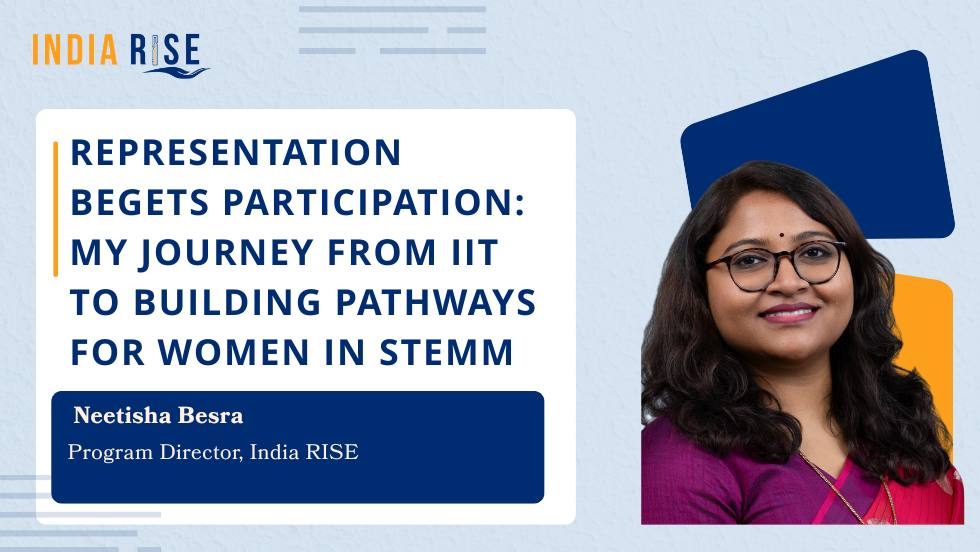
Growing up in Jamshedpur, the Mecca of steelmaking, life felt like a level playing field. I had short hair, raced the boys on the track, believed that nothing could stop me from excelling in academic, sports or public speaking. Some may say, I was very competitive, but I was merely mimicking those who were allowed to stay outdoors, who wore bruised knees as badges of honor, clinking medals adorned on sun-tanned skin and had calf muscles to die for. I learnt that with skill and hard work, I could achieve pretty much anything. My parents were progressive enough to think that becoming a metallurgical engineer made perfect sense for their daughter. After all, in a city built on steel, what better future than one forged in it? But I soon discovered that it takes more than skills and effort to thrive in college or at work. A Minority in the Halls of Merit When I entered IIT, I was one of just 34 girls in a batch of nearly 700 students. At least Metallurgy was better than Mechanical Engineering that year, which had one woman “holding the fort.” In classrooms and labs, the ratio was not just a number; it defined how you were seen, spoken to, and sometimes, how much you spoke. Unlike students in the social sciences, we were never taught or trained to have the vocabulary to articulate what it meant to live and learn in a gendered world. When you’re five percent of the class, you’re both visible and invisible, grateful to be there, but aware that your every move is amplified. As in any society where norms are set by the majority, we were learning how to adapt where the boys were the norm. Each one of my female classmates went above and beyond to excel. We dressed for utility, adopted the “tough engineer” persona, that became our silent uniforms of belonging. Acceptance came in many forms: blending in, toughening up, or occasionally, opting out. We were respected for having made it, yes, but were also pedestalized. We were also envied for being preferentially treated. Because the other 3 secretaries of the electronics club thought that one female secretary had an easy interview because of her gender. Sisterhood and Silent Struggles The girls’ hostel became our safe haven. As hostel president, I witnessed both the quiet strength and the hidden struggles that often went unseen. Academic pressure combined with the emotional turbulence of adolescence was no small weight to carry. Some students were dealing with personal losses, health challenges, or questions of identity all while meeting the relentless demands of IIT life. Some couldn’t take it. A few are no longer with us. It remains a sobering reminder that meritocratic spaces often overlook the human need for care, empathy, and mental health support. But there was also camaraderie, shared laughter during late-night errands to the canteen, whispered confessions before exams, collective pride when one of us topped a course or aced a project. Those years taught me that community is not just a comfort, it’s a survival strategy. Policy as a Catalyst for Change Much has changed since those days. IITs now have a quota ensuring at least 20 percent of seats for women. It’s a transformative policy, one that not only opens doors but also shifts mindsets of families, schools, and society. When parents see a higher probability of success, they’re more likely to encourage daughters to try. Policies like these challenge self-limiting beliefs. They show that representation doesn’t dilute merit, it expands it. Academia, after all, stands at the crucial intersection of society and workforce. If universities can normalize women’s presence in scientific spaces, industries will have no excuse to say “we couldn’t find qualified women.” From Classrooms to the Oilfields After graduation, I carried those lessons into the oil and gas sector, an environment even more skewed. My first year as an oilfield engineer was spent across remote rigs where I was often the only woman. Field life was a test of endurance. Water shortages made menstruation management a daily logistical challenge. Safety meant guarding against occupational hazards, not harassment; the idea of “women’s safety” simply didn’t make the checklist. The technicians and engineers I worked with respected skill above all. Once they saw I could troubleshoot and handle a shift, I was one of them. Still, it was clear that these workplaces weren’t designed for women, they merely accommodated us. The design of the jumpsuits, no separate facilities for women and the shifts & systems have barely ever anticipated the needs of a working mother. Minority barely determined the policy for the majority. I wish like politics, even workplaces saw us as a vote bank. That experience cemented my belief that inclusion cannot depend on individual resilience, it must be engineered into the system. From Personal Lessons to Institutional Change Years later, when I joined Johns Hopkins University’s Gupta-Klinsky India Institute (GKII), the questions I carried from IIT and the oilfields resurfaced:Why are there so few women leading scientific research in India? What would it take to change that pipeline not just at entry, but through leadership? These reflections led to the creation of the India RISE Fellowship a flagship initiative that I now lead. RISE (Research, Innovation, Science, and Empowerment) is designed to strengthen the leadership, research capacity, and visibility of early-career Indian women in STEMM. It connects fellows with senior mentors from India and the U.S., equips them with leadership training, and creates networks for global collaboration. Through RISE, I see how policies, mentorship, and representation can together transform trajectories. Each fellow’s journey reaffirms what I witnessed years ago: women don’t lack capability they lack systemic support. The Road Ahead Representation begets participation. But participation alone isn’t enough. We need persistence and progression. Academia must continue to be the laboratory where gender equity is not just researched but practiced. We have made progress in classrooms; now the challenge lies in ensuring those women enter and stay in the
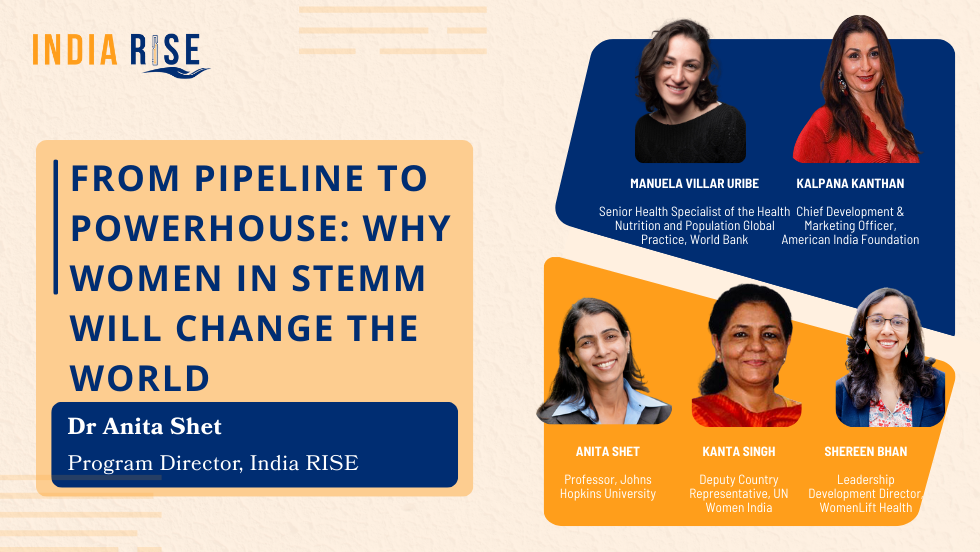
During my medical internship in Bangalore, I often noticed the daughter of the cook in the hospital canteen. She would sit in a corner after school, her notebooks stained with the smell of spices. On the rare occasions when we spoke, her eyes would light up as she described her dream of becoming a doctor. It seemed improbable though, her family’s modest means, the weight of social expectations, and the sheer scarcity of opportunity stacked against her. But the extraordinary happened: her father encouraged her ambitions, the hospital leadership rallied behind her, and alumni scholarships opened doors that might otherwise have remained closed. Years later, she walked into the medical college as the first doctor in her family. Her journey reflects, in microcosm, the transformation we need at scale: moving women from being part of a “pipeline” of talent to becoming powerhouses of innovation and leadership. At 2025’s Hopkins India Conference, I chaired a closing panel titled From Pipeline to Powerhouse: Catalyzing Women’s Leadership in STEMM. It convened four formidable leaders, Kanta Singh (UN Women India), Shereen Bhan (WomenLift Health), Kalpana Kanthan (American India Foundation), and Manuela Villar Uribe (World Bank), to reflect on what it truly takes to create equitable systems in science and technology. What emerged was not a perfunctory conversation about numbers or token representation, but a deeper excavation of the barriers that continue to shape and often constrain women’s experiences in STEMM. Midway through the panel, I posed a simple question to the audience of academics, industry leaders, students, and policy professionals: How many of you have been the only woman in a professional room? Hands rose across the hall. That simple moment captured the very systemic issue we are trying to solve. I was struck by the clarity of voices calling for more than mere representation. We were reminded that safety at home, in public spaces, in workplaces, and increasingly online, remains one of the most persistent barriers to women’s empowerment. Equally resonant was the recognition that empowerment requires financial independence and the courage to risk failure and recovery. We talked about the catalytic role of mentorship and male allyship. Genuine change requires everyone, including men, to challenge ingrained biases, both within workplaces and within families. Yet women continue to shoulder disproportionate caregiving responsibilities and remain systematically excluded from the leadership circles where funding priorities are determined. Agency, as the panelists emphasized, is not bestowed overnight. It demands institutions reimagine their policies and embed gender sensitivity into the very architecture of their operations. Writing this, I am reminded of why this work matters so deeply. Of how we need more ladders that will enable daughters to ascend from the smoky kitchens of subsistence into the luminous laboratories of discovery, carrying with them not just their own aspirations but the untapped genius of entire communities. Empowering women in STEMM is about reshaping the trajectory of science, technology, and humanity itself. So here is my call to action. For individuals, the call is to pursue opportunities for leadership unapologetically and to extend the same encouragement to younger women who walk the path after you. Refuse to normalise gender stereotypes and practise every day acts of allyship — credit the originator of an idea when someone is talked over, invite new voices into familiar networks, and seek out mentors as much as you offer mentorship yourself. Small acts of resistance accumulate into cultural change. For institutions, the responsibility lies in building structures that allow women to thrive without penalty. This means embedding gender-sensitive policies such as flexible working hours, comprehensive parental leave, and zero-tolerance enforcement of workplace harassment. It also means recruiting and retaining women in decision-making roles so that they can shape funding priorities and the future of science. Beyond policies, institutions must prepare the broader ecosystem — investing in exposure, skills, and career transitions, and ensuring that workplaces are truly ready to hire, train, and promote women. There is a line from Shirley Chisholm that I often recall, about bringing a folding chair when a seat at the table is denied. Perhaps it is time to redesign the table, to build spaces where women are not the exception but the norm, not present by invitation but by right. For empowering women in STEMM goes beyond justice alone, it is about recalibrating the trajectory of the world. When women rise, they do not rise alone; they lift whole societies with them.
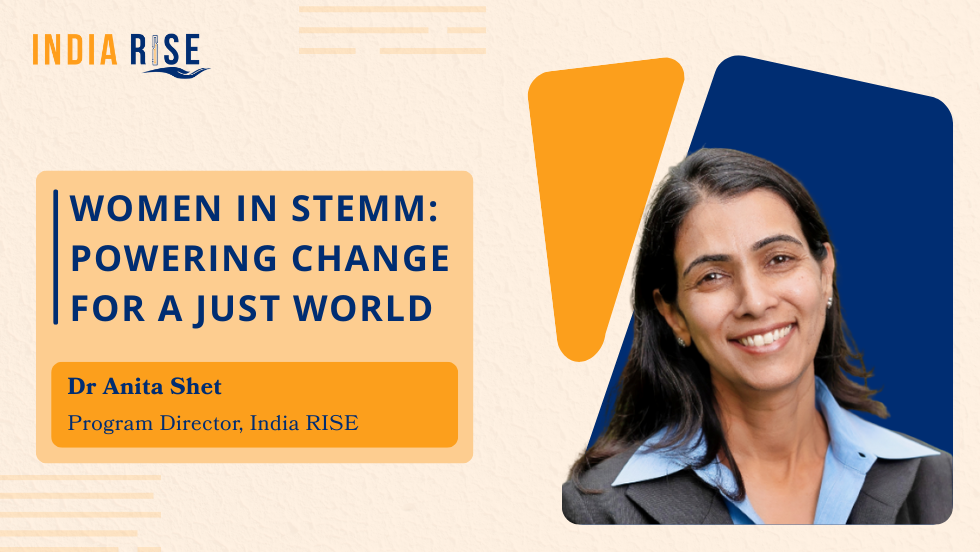
Determination and worry mingled on the young mother’s face as she cradled her one-day-old premature infant against her chest, offering life-saving warmth. In the crowded district hospital in rural Karnataka, where I was posted as an intern, only one incubator was functional, and it was already occupied. Refusing to accept that her child would go without, she fashioned a makeshift incubator using a hot-water bottle wrapped in cloth, a cardboard box lined with her spare sari, and a hand-fan for ventilation. The medical staff, initially doubtful, soon saw the infant’s temperature hold steady. The newborn survived the precarious first week not because of modern machinery, but because a mother dared to innovate with what she had. Years later, I still think of her. I never learned what became of the mother or her baby, but I know she will never be named as an inventor, nor given the chance to cultivate her gift for ingenuity. And I cannot help but wonder: how much does society lose when women like her are denied opportunity and recognition? The privilege of being a woman in science is not one I carry lightly. My own journey, from the frenetic wards of a hospital in Bangalore to the classrooms and corridors of Johns Hopkins, owes itself to a constellation of mentors, institutions, and serendipitous opportunities. Yet what this journey has indelibly taught me is that women in science are not mere adjuncts to discovery, nor passive participants in laboratories. When given the right opportunity, Women can reframe paradigms, question inherited wisdom, and imbue the enterprise of science with perspectives rooted in lived experience. History reminds us that breakthroughs often happen when women dare to step into spaces that seemed closed to them. In India, Dr. Anandibai Joshi became the country’s first degree-holding woman physician in 1886, carving a path in a time when women were rarely educated, let alone trained in medicine. Fortunately, she had an encouraging father and a supportive husband who helped her achieve these goals. A century later, Dr. Suniti Solomon defied prevailing societal silence to identify the first cases of HIV in India, displaying extraordinary courage in confronting a stigmatized subject and opening the door for an entire field of research and care. When women are empowered to stride confidently into the domains of science, technology, engineering, mathematics, and medicine (the now familiar acronym of STEMM), the dividends to society can be exponential. Time and again we witness how women leaders in health research instinctively shape equity and access, invariably asking with moral clarity: who is being left behind? In my own work with adolescents living with HIV in India, I have seen this metamorphosis unfold in front of my eyes: when entrusted with the instruments of science and leadership, girls who once hovered on the margins constrained by circumstance, emerge as eloquent advocates for themselves and their peers. To invest in women is not to fill a gap; it is to expand the possibilities of what science can be and who it can serve For me, the question is no longer whether women belong in STEMM. They most certainly do. The question is whether we, as individuals, societies and institutions, will build the scaffolding for women not just to enter, but to flourish. How we can be the architects of a society that recognizes and nurtures the true potential of women like the young mother of my internship days. The India RISE Fellowship is one such initiative aiming to empower early-career women in STEMM to discover their inner compass in both research and leadership. To build their confidence to not only transform their own lives but recalibrate the aspirations of entire communities. To cultivate a “pay-it-forward” culture of mentorship that grows into a just and lasting future. This is the future I want to be part of. A future we must all commit to creating. Because when women in STEMM drive discovery, they help the world heal and thrive.
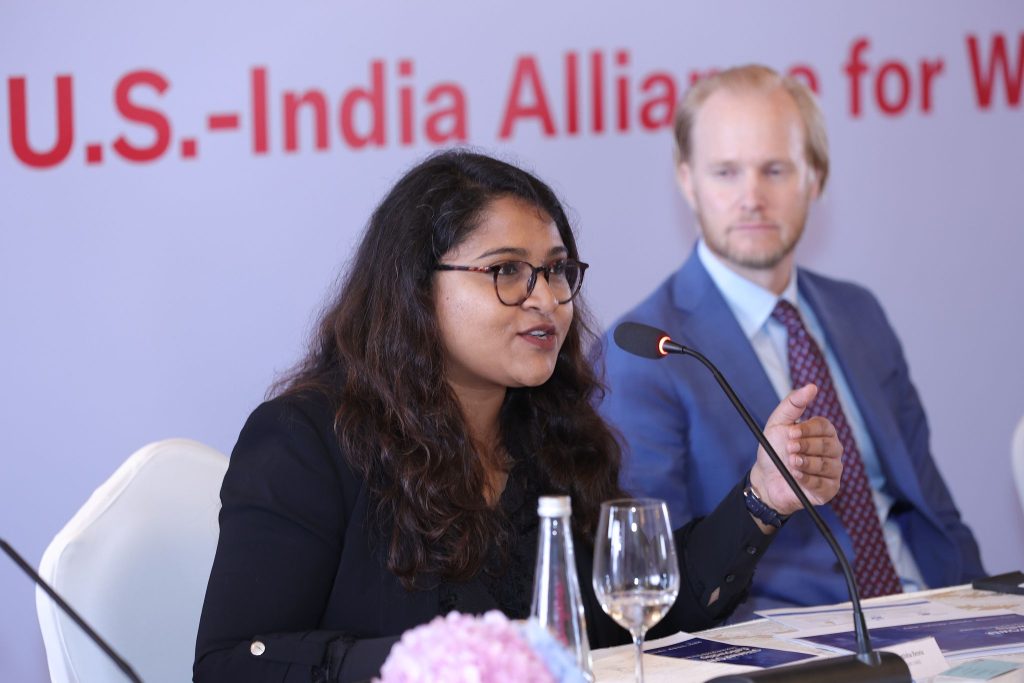
The U.S.–India Alliance for Women’s Economic Empowerment held its first in-person meeting in New Delhi, bringing together public and private stakeholders to advance women’s economic participation, with GKII highlighting its Women in STEMM initiative.

GKII convened a consultation workshop with higher education partners under the U.S.–India Alliance for Women’s Economic Empowerment to address gaps in women’s participation in STEMM.