

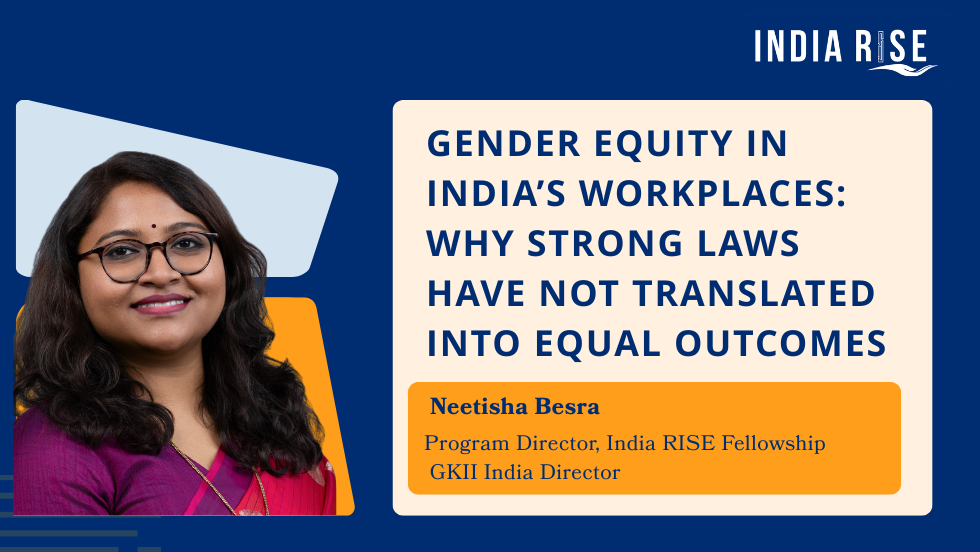
Gender Equity in India’s Workplaces: Why Strong Laws Have Not Translated into Equal Outcomes
India is often described as a country with a robust legal framework for gender equality at work. Constitutional guarantees, maternity benefits, workplace safety laws, and equal pay provisions together suggest a strong commitment to women’s rights in the labour market. Yet, when measured by outcomes rather than intent, India continues to perform poorly on women’s participation, leadership, and economic power. This gap between policy design and lived reality points to a deeper challenge: gender equity in India has been treated largely as a matter of legal compliance, rather than as a problem of institutional design and accountability. To understand why progress has stalled, it is necessary to examine where India truly stands today not just in terms of participation numbers, but in the quality of work and access to leadership that women experience. Where India Stands Today: Participation Without Power India’s Female Labour Force Participation Rate (FLFPR) has seen a notable rise in recent years, reversing a long period of decline. Data from the Periodic Labour Force Survey indicates that FLFPR increased from 23.3 percent in 2017–18 to about 41.7 percent in 2023–24, with some estimates placing participation in the range of 32 to 42 percent depending on measurement methods. At first glance, this appears to be a long-awaited turning point for women’s economic participation in India. However, the nature of this increase complicates the narrative. Much of the recent growth has been driven by rural women entering self-employment, particularly in agriculture. This shift is widely understood as distress-driven participation, reflecting economic necessity rather than the expansion of decent, productive employment opportunities. Many women have entered low-paying, informal, and insecure work as household incomes came under pressure. Participation has increased, but the quality and stability of work remain deeply uneven. The gender gap also remains substantial. Male labour force participation continues to hover around 77 percent, underscoring how far India still lags both its own male workforce and global comparators. Analyses by the World Bank Group consistently show that India’s female participation remains well below that of middle-income countries, despite recent gains. Formal employment among women has grown, as reflected in rising female enrolment in provident fund systems, but this growth is concentrated in specific sectors and regions, leaving large sections of women outside stable, formal employment. Structural barriers continue to shape these outcomes. Women shoulder a disproportionate share of unpaid care and domestic work, limiting their ability to access full-time or higher-quality employment, particularly in urban labour markets. Cultural norms around marriage, caregiving, and women’s mobility further restrict opportunities, even for educated women. The result is a labour market where women’s participation is rising, but meaningful choice, security, and advancement remain constrained. These structural weaknesses become even more pronounced when one examines women’s representation in research, development, and leadership roles. India produces one of the highest proportions of women STEM graduates globally, yet women account for only about 14 to 18 percent of scientists and professors in leading academic and research institutions. In decision-making spaces whether universities, laboratories, corporate boards, or innovation ecosystems women remain markedly underrepresented. The challenge, therefore, is not a lack of talent, but the systematic filtering out of women as careers progress. The Leaky Pipeline from Education to Leadership India’s gender gap is often described as a “leaky pipeline,” and nowhere is this more evident than in the transition from education to leadership. Women enter higher education and early-career roles in significant numbers, but their presence declines sharply at mid-career and senior levels. This attrition is rarely driven by lack of ambition or ability. Instead, women encounter cumulative institutional barriers: opaque promotion systems, workplace cultures that penalize caregiving, inadequate safety and mobility support, and the absence of women in senior decision-making roles. Short-term interventions such as fellowships and re-entry schemes have helped individual women remain in the system, but they have not altered the structures that govern hiring, promotion, and leadership selection. As a result, women remain clustered in junior roles while senior positions continue to be dominated by men. Without structural reform, the pipeline continues to leak at every stage. India’s Policy Architecture for Gender Equality: Ambitious and Expansive India’s gender equity framework rests on a strong constitutional foundation. Articles 14, 15, and 16 of the Constitution guarantee equality before the law, prohibit discrimination on the basis of sex, and ensure equal opportunity in public employment. These principles are reinforced through a series of landmark legislations that address both public and private spheres of women’s lives. The Protection of Women from Domestic Violence Act (2005) recognizes physical, emotional, sexual, and economic abuse, extending legal protection beyond narrowly defined notions of violence. The Sexual Harassment of Women at Workplace (Prevention, Prohibition and Redressal) Act (2013) mandates safe working environments across public and private sectors, formally acknowledging that women’s participation depends on dignity and safety at work. The Maternity Benefit (Amendment) Act (2017) expanded paid maternity leave, signaling state recognition of reproductive labour. Alongside legal protection, the government has launched a range of schemes aimed at empowerment and economic inclusion. Beti Bachao Beti Padhao sought to address declining child sex ratios while promoting girls’ education. Programs such as the Rashtriya Mahila Kosh and Mahila Shakti Kendra have focused on micro-credit, skills, and livelihood support, particularly for rural women. Maternity-linked income support through the Pradhan Mantri Matru Vandana Yojana and childcare support under the National Crèche Scheme were designed to ease the care burden that often forces women out of the workforce. Political representation has also been a key lever. The 73rd and 74th Constitutional Amendments mandated 33 percent reservation for women in Panchayats and Urban Local Bodies, dramatically increasing women’s presence in local governance. More recently, the Women’s Reservation Bill passed in 2023 promises 33 percent reservation in Parliament and State Assemblies, signaling renewed political intent, even as implementation remains pending. Complementing these efforts are gender budgeting initiatives and the National Policy for Empowerment of Women (2001), both of which aim to mainstream gender considerations across state action rather than isolate them within women-specific departments.