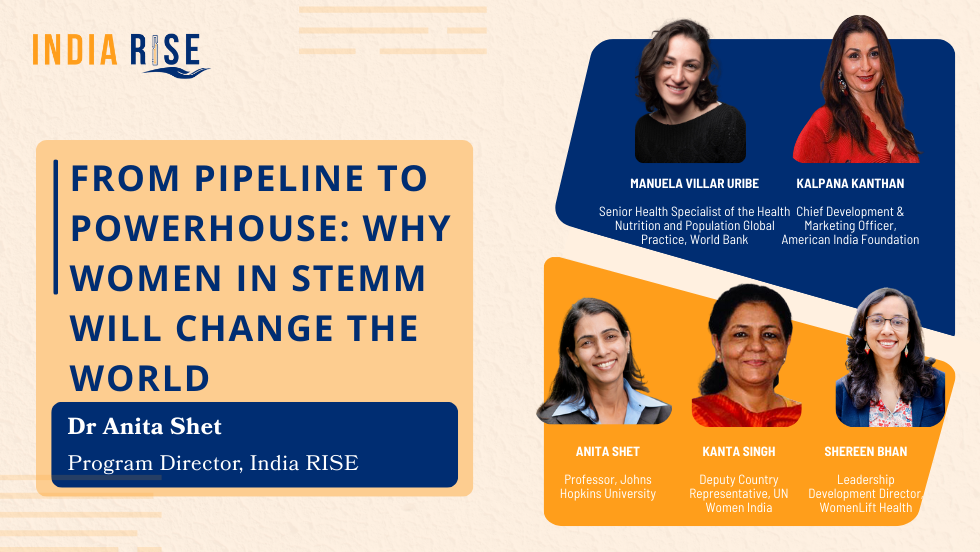


At the Hopkins India Conference 2026, the Gupta-Klinsky India Institute at Johns Hopkins University convened a roundtable titled “Reimagining Women’s Leadership in STEMM Research: Institutional Reforms That Work.” The discussion brought together senior voices from academia, policy, philanthropy, and global development to examine a persistent contradiction in India’s research ecosystem: while women’s participation in STEMM education has steadily increased, leadership within research institutions continues to remain disproportionately male.
As part of the convening, the India RISE Fellowship invited fellows to submit practitioner-grounded institutional reform proposals based on their lived experiences within Indian research ecosystems. Selected fellows then presented their ideas directly to our panellists.
What emerged was a powerful reminder that many of the barriers shaping women’s careers in STEMM are neither invisible nor inevitable. They are institutional. And importantly, they are reformable.
Moving Beyond Mentorship Toward Sponsorship
Across the presentations, one theme surfaced repeatedly: mentorship alone is insufficient without systems that actively create visibility and leadership opportunities for women researchers.
Drawing from her experience within academic research environments, Dr. Sushama Agarwalla (IIT Hyderabad) argued that leadership progression often depends less on talent than on access to institutional networks, sponsorship, and nomination pathways that frequently remain informal and opaque.
Her proposal focused on introducing structured sponsorship systems within institutions, where senior faculty and administrators would take explicit responsibility for recommending early- and mid-career women researchers for grants, committees, and leadership roles. She also proposed institutional dashboards to track women’s participation in leadership positions and decision-making structures over time.
Similarly, Debyashreeta Barik, Ph.D., working in biotechnology and nanomedicine, highlighted the absence of formal mentorship and sponsorship pathways for women researchers navigating early career transitions. While informal mentoring relationships may exist, she noted that access often depends heavily on personal networks and institutional proximity.
Her proposed reforms included structured mentorship programmes, leadership development support, and sponsorship mechanisms that would actively connect women researchers to collaborative projects, institutional committees, and funding opportunities. She also emphasised the need for re-entry pathways for researchers returning after caregiving-related career interruptions, including bridge funding, flexible promotion timelines, and temporary research support.
Together, these proposals reflected a broader shift in the conversation around women in STEMM, from “fixing confidence gaps” to redesigning institutional systems that determine visibility, recognition, and advancement.
The Invisible Labour Behind Academic Leadership
In a particularly striking intervention, Anubhuti Joshi (AIIMS Rishikesh) examined what she described as the “hidden tax” placed on unmarried women researchers through a phenomenon known as singlism. Within many academic environments, she argued, unmarried women are often informally expected to absorb additional teaching, coordination, mentorship, and administrative responsibilities because they are perceived as more “available” than married colleagues.
While these expectations rarely appear in formal policy, they accumulate over time in ways that directly affect research productivity, publication output, networking opportunities, and long-term leadership progression.
To address this, Dr. Joshi proposed institutional workload transparency systems that would formally audit and track teaching loads, committee responsibilities, mentorship expectations, and administrative labour across departments. She also highlighted the growing precarity of contractual employment in Indian academia, where many women researchers remain excluded from long-term career pathways despite contributing substantially to institutional research output.
Her proposed “contract-to-career-track” pathways aimed to create more stable leadership trajectories for high-performing contractual researchers through multi-year appointments, grant eligibility, and structured leadership development opportunities.
From Individual Resilience to Institutional Design
What made these presentations particularly compelling was their grounding in everyday institutional realities. Rather than framing gender inequity solely through individual experience, the fellows focused attention on how systems distribute opportunity, visibility, labour, and stability across academic life.
The proposals also shared an important characteristic: practicality. None relied on abstract commitments to empowerment or representation. Instead, they centred on reforms institutions could realistically pilot within the next 12–24 months, from workload audits and sponsorship structures to re-entry pathways and expanded evaluation frameworks.
At a moment when India is investing heavily in AI, biotechnology, public health, and advanced research ecosystems, the discussion reinforced a broader point emerging globally: scientific leadership pipelines are shaped as much by institutional design as by individual talent.
The India RISE Fellowship hopes these conversations continue beyond a single convening and contribute to a growing ecosystem of institutions willing to experiment with measurable, accountable reforms that strengthen women’s leadership in STEMM research.