

By Srishti Kapil, Communications Lead at India RISE Fellowship and Programs and Communications Specialist at Gupta-Klinsky India Institute at Johns Hopkins University
Before I knew what a laboratory smelled like, what scientists did all day, what degrees they needed or what their work paid, science arrived as photographs in newspapers, rockets on television, school assemblies after major launches, and women whose names suddenly seemed to belong to the whole country.
I remember Kalpana Chawla this way.
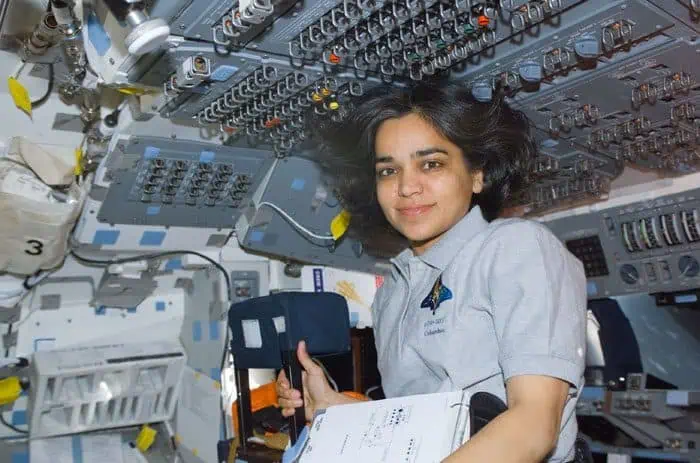
On 1 February 2003, the Space Shuttle Columbia broke apart during re-entry, killing all seven astronauts aboard. Chawla was one of them. I was young enough that the mechanics of what had happened were beyond me. What I understood was simpler and, perhaps, more important. An Indian-born woman had gone to space. She had gone somewhere so far away that we had to look upward to describe it.
Space, which until then had belonged to rockets and planets and diagrams in textbooks, acquired a human face for me. A woman’s face.
I think children learn professions this way. We collect them as images long before we encounter them as choices.
Years later, I watched Barkha Dutt anchor We the People and Shekhar Gupta host Walk the Talk. Through those programs, I encountered conversations that rarely reached the classrooms and neighbourhoods of the smaller towns where I grew up. I remember writing unfamiliar words in my diary, looking them up in the thick thesaurus we kept at home, and trying them out the next day to impress my English teacher. I wanted to be a journalist.
For a while, I also wanted to be a detective. This ambition was entirely Nancy Drew’s fault. I spent enough years following her through hidden staircases, missing wills and suspicious strangers to become convinced that adulthood might consist of noticing what everyone else had missed.
Astronaut. Reporter. Detective.
My childhood occupations had costumes. A spacesuit. A microphone. A magnifying glass, at least in my imagination. You could draw them.
My actual career is harder to draw.
Most days it looks like a desk and a laptop. Tabs. Drafts. Comments in margins. Emails that multiply while I answer them. Some days I work on something that feels consequential, a story, an argument, a program trying to shift some small piece of the world. On other days I change the wording in a document for the seventh time because an institution has decided that one adjective is safer than another. I had no childhood image for this kind of work.
What the screen permits
The distance between media and STEM feels much smaller to me than we often make it sound. Before someone applies for engineering school, sits an entrance exam or walks into a laboratory, she has already spent years receiving messages about the sort of person who belongs there.
UNESCO currently estimates that women make up roughly one-third of researchers worldwide and 35% of STEM graduates globally. Across G20 countries, women hold only 22% of STEM jobs. San Diego State University’s 2025 analysis of top-grossing US films found that women accounted for 38% of speaking characters. The share of films with female protagonists had fallen from 42% in 2024 to 29% in 2025.
ROX’s 2024 Girls & STEM Impact Report, based on a US survey of 17,502 girls in grades 5 through 12 conducted during 2022 and 2023, found that 55% were considering a STEM career, up from 45% in its 2017 study. At the same time, the share who believed they were good at maths and science had fallen from 73% to 59%. Interest had grown while belief in their own ability had weakened. That contradiction stays with me.
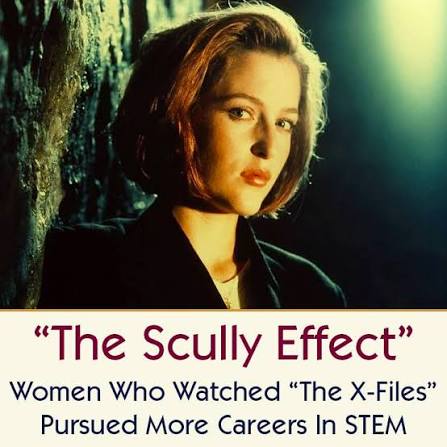
The same ROX study found that confident girls were 20% more likely to consider STEM careers. Girls whose teachers treated them as though they were smart were 56% more likely to express interest in a STEM occupation. The Geena Davis Institute’s study of ‘Scully Effect’ found that, among women familiar with The X-Files character, half said Scully had increased their interest in STEM. Sixty-three per cent said she had increased their confidence that they could excel in a male-dominated profession. A fictional scientist had altered how real women understood their own possibilities.
Who gets remembered
Of course, getting women into the scientific imagination solves only the first problem. There is another question waiting at the other end of the career.Who gets remembered?
In 1993, historian of science Margaret Rossiter gave a name to the systematic under-recognition of women’s scientific contributions: the Matilda Effect, named after nineteenth-century suffragist Matilda Joslyn Gage. Rossiter described a history in which women scientists could be ignored, denied credit, or gradually disappear from the account of work they had helped produce.
Research conducted years after Rossiter coined the term suggests how persistent those mechanisms can be. Anne Lincoln and colleagues examined awards and prizes across US scientific societies. For scholarly research awards between 2000 and 2010, men were twice as likely to win after accounting for their representation in the nomination pool. Committees chaired by men awarded prizes to men 95.1% of the time, even though women made up 21% of the nominees considered by those committees.
A 2013 experiment by Silvia Knobloch-Westerwick, Carroll Glynn and Michael Huge offered 243 young communication scholars conference abstracts carrying male or female author names. The work associated with male authors was judged higher in scientific quality, particularly when the subject itself was perceived as male-typed.
Women for Mars
Indian cinema has made this question personal for me. When Mission Mangal (2019) arrived, I was hungry for what it offered: a room full of Indian women doing science. The film is a heavily dramatised account inspired by ISRO’s Mars Orbiter Mission, Mangalyaan, which launched in November 2013 and entered Mars orbit the following year. The women in the film were busy, funny, tired, dressed like people I might actually encounter in an office or on the metro. Tara Shinde, played by Vidya Balan, could move between the Mars mission and the domestic logistics of her family without acquiring the cold, alien temperament popular culture has so often assigned to brilliant women.
For a film populated by female scientists, Mission Mangal remained heavily marketed through Akshay Kumar’s stardom. Contemporary coverage explicitly discussed the prominence of his face on the posters, while reviews described Tara as simultaneously carrying scientific responsibility and an exhausting catalogue of domestic duties. Even the official synopsis placed Rakesh Dhawan and Tara Shinde together at the head of the team.
The women had finally reached Mars.
The poster still seemed nervous about sending them there alone.
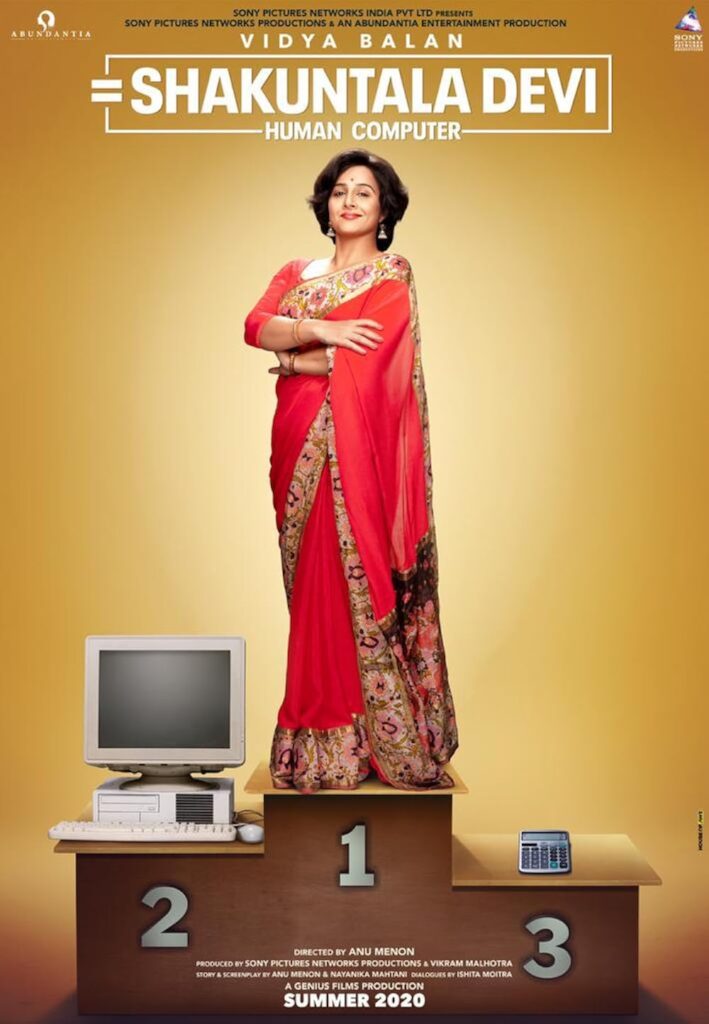
I felt a related unease watching Shakuntala Devi (2020). Vidya Balan’s character occupies the centre of the film as a woman of spectacular numerical ability, a rare pleasure in itself. Yet much of the emotional architecture of the biopic is built around motherhood and the fractured relationship between Shakuntala Devi and her daughter. Reviewers repeatedly described the film through that tension, including one as a “tightrope walk between maths and motherhood.”
The tension belongs to her life, so erasing it would produce another distortion. But male genius has been granted a remarkable range of domestic permissions. Obsession can demonstrate seriousness. Emotional inadequacy can become eccentricity. Failed relationships can become collateral damage on the road to greatness.
But a woman arrives home carrying an award.
Was she a good mother? A good wife? Was everybody around her sufficiently loved? Did achievement cost her femininity? Could she have had all that intelligence and somehow remained easier to live with?
Her genius enters the story already cross-examined.
When the maths gets to be the plot
This may be why Hidden Figures (2016) remains so satisfying to me.
The film gives calculation dramatic weight. Katherine Johnson stands before equations because the equations matter. Dorothy Vaughan understands that computational work is changing and learns FORTRAN. Mary Jackson fights to become an engineer. The real women did work of enormous consequence at NASA. Johnson calculated trajectories for human spaceflight, including work associated with John Glenn’s orbital mission; Vaughan led the West Area Computing unit; Jackson became NASA’s first Black female engineer. NASA itself describes the mathematical calculations performed by Johnson, Vaughan and Jackson as crucial to the success of Project Mercury missions.
Perhaps that is the thing I have been trying to understand since Kalpana Chawla first appeared on a television screen in my childhood.
Dreams are socially rehearsed.
A child has no labour-market statistics. She does not know the gender composition of a discipline or the structure of a doctoral program. She is collecting evidence of another kind.
Who gets handed the difficult problem?
Who knows the answer?
Who is believed when she gives it?
Who gets interrupted?
Who stands at the front of the room?
Who gets photographed beside the machine?
Whose name survives the story?
And perhaps most importantly: who looks as though she belongs there before she has done anything extraordinary at all?
That last question matters because representation built entirely from exceptional women carries its own burden. The first woman. The only woman. The woman who overcame everything. The genius. The astronaut. The human computer.
I grew up admiring these women. I still do.
But girls deserve mediocrity too.
They deserve the scientist who has a boring Wednesday. The researcher waiting for ethics approval. The coder staring at an error she cannot find. The field scientist sweating through an afternoon that produces no breakthrough. The doctoral student who is uncertain. The woman whose work matters without becoming a national parable about female achievement.
We need more women at the centre of discovery. More women behind the camera deciding how discovery looks. Women working together rather than existing as the single extraordinary woman in a room of men. Women allowed ambition without punishment, competence without loneliness, failure without becoming evidence against their sex.
Most days, I still sit in front of a screen. The same portal that once brought me an astronaut, a detective and, later, all the fictional lives I thought I might grow into now holds my drafts, emails, research, edits and the strange mixture of consequential and mundane work that became my actual career.
That is why I take screens seriously. Somewhere, a girl is looking at one before she knows what she wants.
She is learning what a scientist looks like. What a journalist looks like. What intelligence looks like when it walks into a room.
By the time someone asks her what she wants to become, I hope possibility has already become familiar.

Communications Lead, India RISE Fellowship and Programs and Communications Specialist, Gupta-Klinsky India Institute at Johns Hopkins University